U.K. General Election
VOTE-SCOPE FORECAST · PROPRIETARY PROJECTION · EXCLUSIVE ADJUSTMENTS

RACE BOARD · RUN 2026-09-16
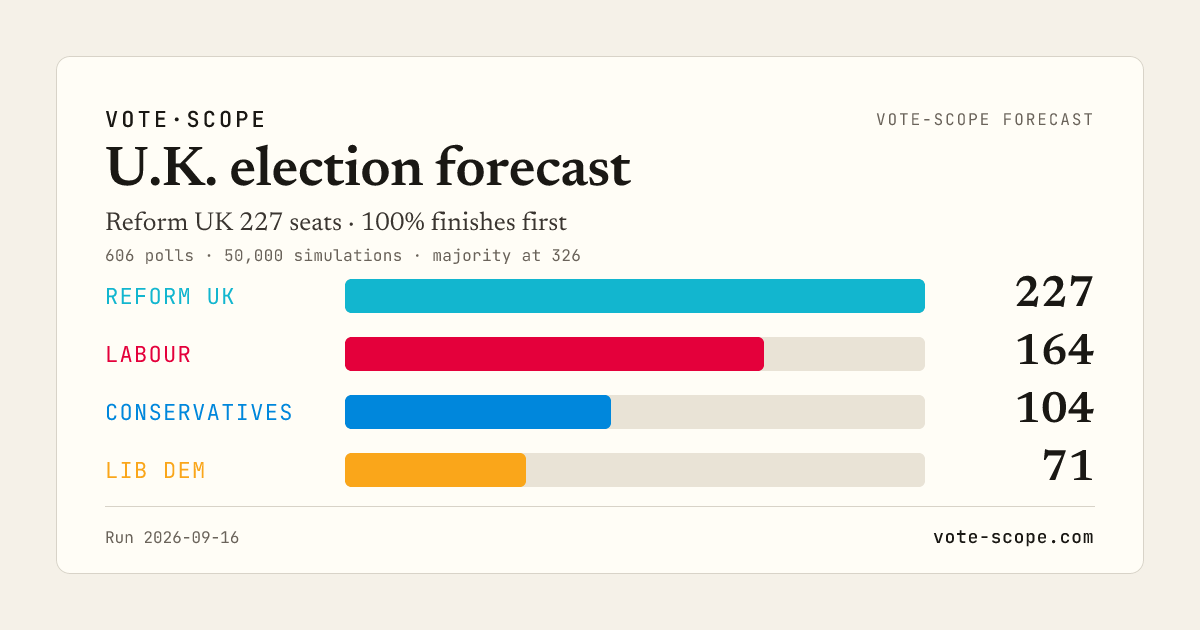
Reform leads the old race. Burnham just started a new one.
606 polls · 50,000 simulations · our exclusive read of the race
Watch list
The tightest races
Smallest projected margin. Open one for the numbers.
Current House of Commons Composition
Seats — 650 total
- Labour 409
- Conservative 122
- Liberal Democrat 72
- SNP 8
- Other 8
- Green 5
- Reform UK 5
- Plaid Cymru 4
- Vacant 1
Seat projection
 Reform UK
 - Vote
- 23.5%
- P(majority)
- 0%
- P(largest)
- 100%
 Labour
 - Vote
- 25.5%
- P(majority)
- 0%
- P(largest)
- 0%
 Conservative
 - Vote
- 20.3%
- P(majority)
- 0%
- P(largest)
- 0%
 Liberal Democrat
 - Vote
- 11.0%
- P(majority)
- 0%
- P(largest)
- 0%
 SNP
SNP - Vote
- 2.6%
- P(majority)
- 0%
- P(largest)
- 0%
- Vote
- 5.7%
- P(majority)
- 0%
- P(largest)
- 0%
 Plaid Cymru
 - Vote
- 1.1%
- P(majority)
- 0%
- P(largest)
- 0%
 Green
Green - Vote
- 10.5%
- P(majority)
- 0%
- P(largest)
- 0%
Analysis
Vote intention
Raw polls (dots) and model estimate (diamonds) with 95% confidence interval.
Scenario probabilities
Probability of winning a majority or finishing strictly first, across the 50,000 Monte Carlo simulations.
Riding map
Color = projected leading party. Hover a riding for details.
All ridings
Sort and filter the 650 ridings by projected winning party, margin and probability.
| Riding | Prov. | Projection | Vote% | Margin | P(win) | vs 2024 |
|---|---|---|---|---|---|---|
| Birmingham Yardley | England | Other | 0.0% | 0.4% | 52% | New |
| Birmingham Erdington | England | Reform UK | 0.0% | 0.5% | 60% | New |
| Derby North | England | Labour | 0.0% | 0.5% | 62% | New |
| Middlesbrough and Thornaby East | England | Reform UK | 0.0% | 0.5% | 62% | New |
| Broxtowe | England | Labour | 0.0% | 0.5% | 66% | New |
| Bristol South | England | Green | 0.0% | 0.5% | 64% | New |
| Hitchin | England | Reform UK | 0.0% | 0.5% | 62% | New |
| Colne Valley | England | Labour | 0.0% | 0.5% | 91% | New |
| Newton Abbot | England | Reform UK | 0.0% | 0.6% | 78% | New |
| Gainsborough | England | Conservative | 0.0% | 0.6% | 55% | New |
| Romford | England | Reform UK | 0.0% | 0.6% | 56% | New |
| Isle of Wight West | England | Reform UK | 0.0% | 0.6% | 56% | New |
| Dartford | England | Conservative | 0.0% | 0.6% | 60% | New |
| Poole | England | Conservative | 0.0% | 0.6% | 60% | New |
| Portsmouth North | England | Conservative | 0.0% | 0.6% | 60% | New |
| South West Wiltshire | England | Conservative | 0.0% | 0.6% | 61% | New |
| Christchurch | England | Conservative | 0.0% | 0.6% | 61% | New |
| Bracknell | England | Conservative | 0.0% | 0.6% | 62% | New |
| Bournemouth East | England | Conservative | 0.0% | 0.6% | 65% | New |
| West Bromwich | England | Labour | 0.0% | 0.6% | 89% | New |
| South Shropshire | England | Reform UK | 0.0% | 0.6% | 63% | New |
| Forest of Dean | England | Conservative | 0.0% | 0.6% | 64% | New |
| Chesterfield | England | Labour | 0.0% | 0.6% | 89% | New |
| East Renfrewshire | Scotland | SNP | 0.0% | 0.6% | 60% | New |
| Milton Keynes North | England | Conservative | 0.0% | 0.6% | 53% | New |
| Old Bexley and Sidcup | England | Reform UK | 0.0% | 0.6% | 69% | New |
| Moray West, Nairn and Strathspey | Scotland | SNP | 0.0% | 0.7% | 78% | New |
| Wycombe | England | Labour | 0.0% | 0.7% | 73% | New |
| Kensington and Bayswater | England | Labour | 0.0% | 0.7% | 75% | New |
| Dumfries and Galloway | Scotland | Conservative | 0.0% | 0.7% | 83% | New |
| Merthyr Tydfil and Aberdare | Wales | Reform UK | 0.0% | 0.7% | 55% | New |
| Mid Bedfordshire | England | Conservative | 0.0% | 0.8% | 81% | New |
| East Worthing and Shoreham | England | Labour | 0.0% | 0.8% | 100% | New |
| Shrewsbury | England | Labour | 0.0% | 0.8% | 100% | New |
| North East Hertfordshire | England | Reform UK | 0.0% | 0.8% | 81% | New |
| Witham | England | Reform UK | 0.0% | 0.8% | 82% | New |
| Wakefield and Rothwell | England | Reform UK | 0.0% | 0.8% | 89% | New |
| Worcester | England | Labour | 0.0% | 0.8% | 100% | New |
| Swindon South | England | Labour | 0.0% | 0.8% | 100% | New |
| Southampton Itchen | England | Reform UK | 0.0% | 0.8% | 90% | New |
| Maidstone and Malling | England | Reform UK | 0.0% | 0.9% | 85% | New |
| Herne Bay and Sandwich | England | Reform UK | 0.0% | 0.9% | 85% | New |
| Mid Leicestershire | England | Conservative | 0.0% | 0.9% | 88% | New |
| Beverley and Holderness | England | Reform UK | 0.0% | 0.9% | 86% | New |
| North East Cambridgeshire | England | Reform UK | 0.0% | 0.9% | 86% | New |
| Aberdeenshire North and Moray East | Scotland | Conservative | 0.0% | 0.9% | 91% | New |
| Makerfield | England | Labour | 0.0% | 0.9% | 99% | New |
| Cardiff East | Wales | Labour | 0.0% | 0.9% | 57% | New |
| City of Durham | England | Reform UK | 0.0% | 1.0% | 92% | New |
| North East Derbyshire | England | Reform UK | 0.0% | 1.0% | 91% | New |
The race question
Can Prime Minister Andy Burnham rebuild Labour before Reform converts protest into seats?
The change of prime minister resets the political story, not the electoral arithmetic. Any “Burnham bounce” must persist across several polls and translate unevenly across constituencies before the model should move.
How we got here
How we got here
Labour’s 2024 landslide rested on extraordinary seat efficiency and a fragmented opposition. Reform’s rise then challenged Labour in many of the places where Burnham’s northern and communitarian profile is strongest.
Labour elected Burnham leader on 16 July 2026; he became prime minister on 20 July and formed a new cabinet. That is a major regime change whose constituency effect remains an empirical question.
What just changed
What just changed
20 JUL 2026
Burnham forms a new government
John Healey moved to the Treasury, Wes Streeting to Defence, Angela Rayner returned to Housing and Miatta Fahnbulleh took Energy. The reset can affect Labour–Reform contests, but Clacton remains chiefly a test of Reform’s organization and Farage’s hold.
Our read: Wait for several post-transition polls before treating any bounce as durable.
What can still change the race
What can still change the race
- The size and durability of Labour’s post-transition polling movement.
- Whether gains occur in Labour–Reform contests rather than only against Conservatives or Greens.
- The cabinet’s fiscal choices and capacity to turn Burnham’s regional appeal into a national coalition.